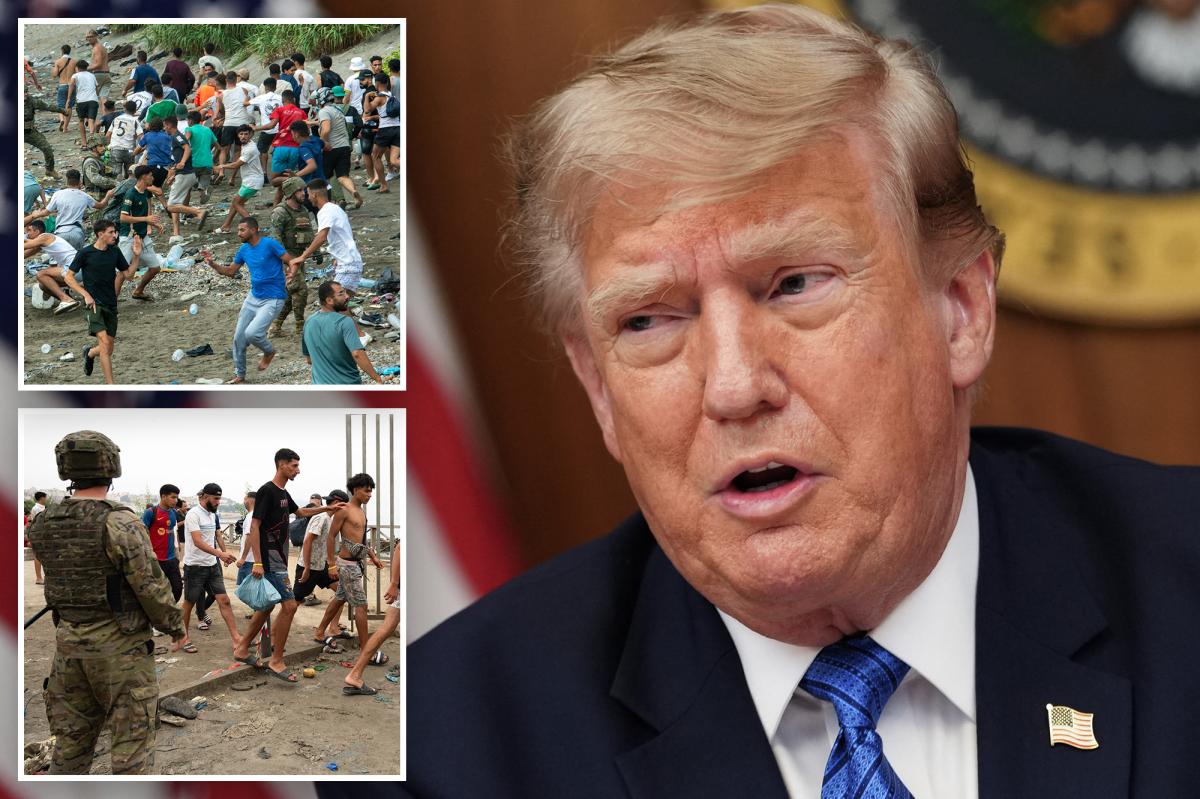
Spain's Chaotic Showdown: What Trump Isn't Backing Down On
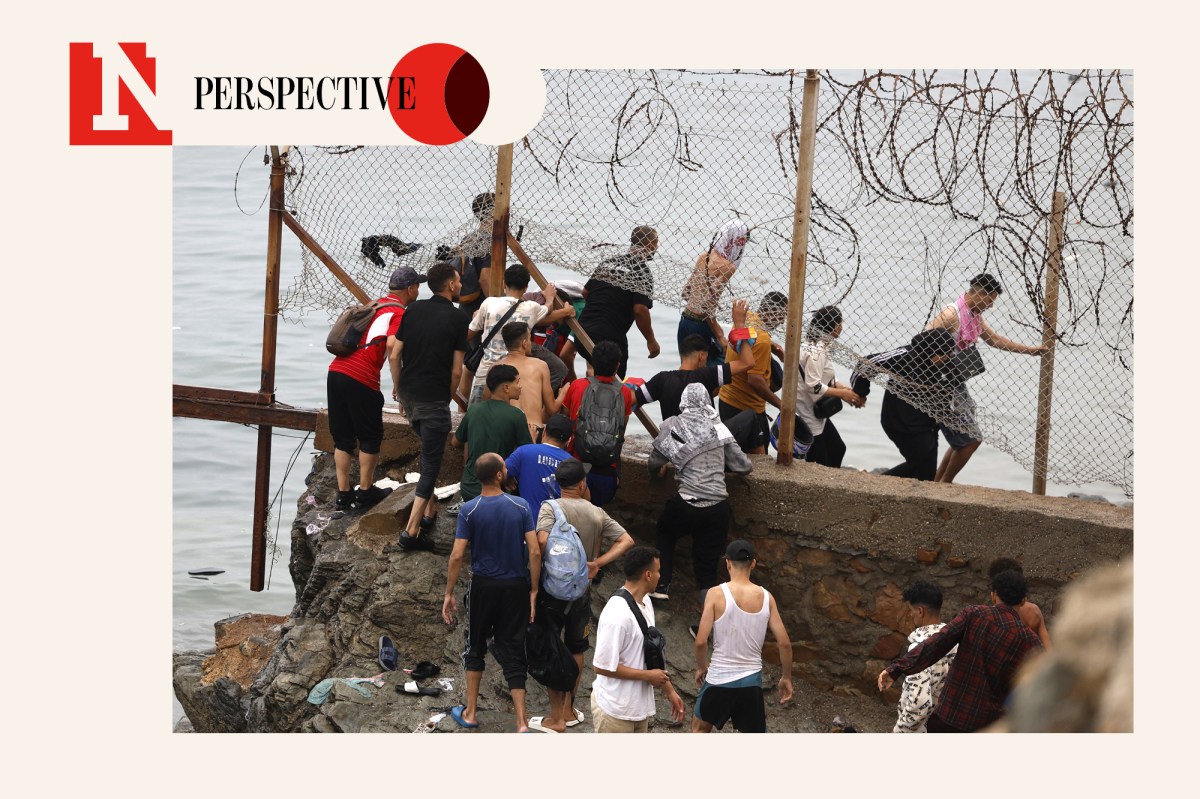
"Viva España!" some of the migrants shouted to a freelance photographer as they came around the Tarajal breakwater into Ceuta, the Spanish enclave on Morocco's northern coast.Watching from the Spanish side, Rachid Sbihi, head of the association representing Civil Guard officers in Ceuta, expressed sentiments heralding the death of Spain instead. "Absolute chaos," he said, adding that the border had "totally collapsed."Confidence in Spain and the collapse of Spanish control, in a single moment. That collision is the key to Spanish Prime Minister Pedro Sánchez's confrontation with President Donald Trump.Madrid keeps declaring its independence from Washington. On five fronts at once, Spain is discovering the distance between asserting sovereignty and holding the leverage to sustain it.1. Borders and ImmigrationSpanish officials estimate some 60,000 migrants have crossed unlawfully into Ceuta in 24 hours, swimming and sailing around the border en masse. Around 25,000 have voluntarily left back into Morocco again, officials said.The Trump White House made clear in its national security strategy that it sees mass migration to Europe as a destabilizing, civilization-destroying phenomenon encouraged by leftist politicians like those governing Spain.Ceuta is its dramatic exhibit: proof, on Trump's telling, that permissive migration policies end in a loss of territorial control.White House spokeswoman Anna Kelly said Trump had long warned Europe about far-left, globalist policies, including mass migration, and that Spain should reverse course "or risk their own demise."Instead, Madrid refused Ceuta's request for a national emergency declaration, on the ground that civil-protection law does not treat migration as a national-security risk—correct as law, terrible as politics.Trump is no longer the loudest voice. Italian Prime Minister Giorgia Meloni signaled readiness for "extraordinary measures," including Spain’s suspension from the Schengen Area, the zone in which EU members allow borderless movement.Spanish-administered Ceuta, which is on the African continent, is not part of the Schengen Area.The shocking footage is inducing renewed panic among European governments and their populations, already anxious about this issue. It is a gift to the nationalist right across the European continent, including in Spain, which in most cases sees itself allied politically with Trump.2. Spain as NATO's 'Wasted Cause'Spain's case about its contributions to NATO is far stronger than Trump admits. Yet Madrid is losing the argument inside the alliance.Sánchez says NATO's Defence Policy and Planning Committee found Spain met its 2026 capability targets with compliance above the European average—seventh best of 32 allies.In early June it was the third-largest contributor of personnel to NATO missions, second in naval capabilities, fourth in air, and the largest ground-force presence on the eastern flank.It has joined NATO's new Arctic mission in Finland. Of the roughly €35.5 billion it spends on defense, 44 percent goes to new equipment, against a NATO average of just over 20 percent.None of that has satisfied the White House. Trump demanded the 2 percent target be raised to shift more of Europe's security burden onto allies and push them to meet 21st-century threats.The Hague target—5 percent of GDP by 2035—is now the public scoreboard.Spain is the only ally that declined to fully commit, arguing that roughly 2.1 percent buys the capabilities NATO actually assigned it.Trump demands "5 percent"—strong, clear, easily understood—while Sánchez must explain that force planning, capability targets and spending composition mean Spain doesn’t need to meet it. Technically sophisticated, politically hopeless.Spain, alone in NATO, looks like the difficult ally weakening it just when strengthening is needed. At the summit in Ankara in early July, Trump called Spain a "wasted cause" and "a terrible partner in NATO," threatening to cut off all trade.Sánchez, at the same summit, said Spain upholds NATO’s values and is "a peaceful and pacifist country," adding that Madrid is "spending more wisely" on defense.3. Spain's Insecure Energy TransitionSpain generated 56.6 percent of its electricity from renewables in 2025 counting self-consumption, added nearly 10 gigawatts of wind and solar, and ran 75.5 percent of generation emissions-free.Sánchez says the result is power roughly 20 percent cheaper than the European average. As an electricity story it is among Europe's best, and anyone arguing Spanish renewables have failed is not reading the data.But electricity is only about a quarter of the energy a modern economy consumes. On the other three quarters—transport fuel, industrial heat, heating—Spain is among Europe's most exposed countries.It imports roughly 70 percent of its total energy against an EU average of 57 percent, and virtually all of its oil and gas—against its own national target of 50 percent by 2030.Spain has built a world-class electricity system on top of a deeply import-dependent energy system.The latter is what troubles Trump, who treats energy security as an urgent defense priority and argues that an emphasis on renewables, coupled with hostility to fossil fuels and nuclear power, leaves the West dangerously exposed.Follow the gas and Trump’s argument is clear. Spain is now one of the European Union's largest buyers of Russian liquefied natural gas.In the first half of 2026 the EU took a record 9.89 million tonnes from the Yamal plant—up 18 percent year-on-year, with Spain third behind France and Belgium.Enagás recorded Russia supplying 27.8 percent of Spanish gas imports in May, up almost 59 percent on the year. At Bilbao, one of Europe's largest import hubs, the Russian share ran at 59 percent from January to May while the American share fell to 40 percent.Energy security and climate leadership have come apart, and Spain built its strategy assuming they were the same thing. Its transition is happening but slow—and meanwhile its import dependency runs straight through hostile leverage.4. The Asymmetrical Trade WarTrump's trade threat is vivid and bilateral; Spain's answer is institutional and European.At the Ankara summit he instructed his treasury secretary, in public, to end commerce with Spain.Sánchez replied that Spain runs a goods trade deficit with the U.S.—although its services surplus leaves total bilateral trade close to balance—and that trade policy is a common European competence.Both are accurate, and both expose the problem: Spain is the named target of a bilateral confrontation while having no bilateral trade policy of its own.Ankara was the second time Trump ordered commerce with Spain halted.After the first threat, in March, trade continued normally. The Supreme Court had struck down Trump’s principal emergency-tariff mechanism the previous month—though Trump keeps finding new and inventive ways to use tariffs.That demonstrates the actual mechanism of leverage: recurring threats and uncertainty. Trump can reopen the trade issue with one sentence, indefinitely. Spain cannot close it alone.Spain is comparatively well placed for a tariff fight. Banco de España found bilateral trade worth 4.4 percent of Spanish GDP against 10.1 percent for the wider euro area.It modeled a blanket 10 percent tariff as hitting the euro area four times harder than Spain—both far below the damage to the U.S. That modeling excludes retaliation and predates the court ruling.The asymmetry is about control, not injury.Trump can single Spain out and inject uncertainty in a sentence. Spain cannot negotiate a concession or impose a counter-tariff alone: Sánchez depends on the Commission and 26 other governments, and any settlement must operate inside EU law.5. Spain’s Moral Dead-End in the Middle EastThe sharpest U.S.-Spain confrontation came over Rota and Morón, the jointly operated bases that remain under Spanish sovereignty.After Madrid refused their use for U.S. strikes on Iran it deemed unauthorized under the U.N. Charter, Trump said the U.S. could simply fly in anyway.Sánchez told the Congress of Deputies that Spain had rejected every Iran-related flight plan, refuelling aircraft included. Fifteen U.S. aircraft left Spain, with at least seven reported to have landed at Ramstein Air Base in Germany.That is a real sovereignty dispute, but the larger cost lies elsewhere. In January, Spain declined to join Trump's Board of Peace, citing international law, the U.N. system and the absence of Palestinian representation.Then came July 30. The body Spain refused to join announced an agreement for the complete disarmament of Hamas and a phased Israeli withdrawal from Gaza—the hardest unimplemented piece of the ceasefire.The deal remains alive but unresolved. Qatar, Saudi Arabia, the UAE and Israel are inside the mechanism. Spain is not. The institution Madrid dismissed as illegitimate is now the primary room where Gaza's future is negotiated.The loss is that Spain's moral distance became diplomatic distance. Madrid now offers little more than words. It has no seat at Trump’s tables where Middle East decisions are made.